
VASI Score in Vitiligo: How to Calculate F-VASI and T-VASI (Free VASI Calculator)

For UK healthcare professionals. Reviewed against NICE TA1140 and CKS, November 2026.

The VASI score in vitiligo (Vitiligo Area Scoring Index) is the standard way to measure how much skin is depigmented and how well it repigments with treatment. Its two versions, the facial VASI (F-VASI) and the total body VASI (T-VASI), were the outcome measures in the trials behind the first dedicated topical vitiligo treatment recommended by NICE. This guide explains how to calculate both scores, what NICE actually requires, and why careful scoring matters in clinic. To skip the arithmetic, use the free Bright Med VASI calculator.
What is vitiligo?
Vitiligo is an acquired, chronic autoimmune condition in which functional melanocytes are lost, leaving white macules and patches on the skin and sometimes the hair [1, 2]. It affects about 0.5–2% of people worldwide and is the most common depigmenting skin disorder [1, 2]. Almost half of people present before the age of 20 [1].
Non-segmental vitiligo is the more common form and is usually symmetrical, often affecting the hands, the wrists, the skin around the eyes and mouth, the axillae and the genitals. Segmental vitiligo is one-sided and accounts for 5–16% of cases [1].
Vitiligo is not "only cosmetic". In a meta-analysis of 25 studies, about a quarter of people with vitiligo had diagnosed depression, and depression was around five times more likely than in controls [3]. NICE CKS advises assessing quality of life and psychological distress every 3–4 months [4].
Treating vitiligo in primary care
CKS and the British Association of Dermatologists (BAD) guideline set out a stepwise approach [4, 5]:
Information and support, including the Vitiligo Society and Changing Faces, and referral to a skin camouflage service.
Sun protection with SPF 50 and a 4- or 5-star UVA rating on the patches and the skin around them.
A potent or very potent topical corticosteroid once daily as first line (off-label), avoiding the area around the eyes.
A topical calcineurin inhibitor (tacrolimus or pimecrolimus) twice daily, as an alternative on the face where there is the expertise (off-label). Do not use in pregnancy.
A review every 3–6 months to check response and adverse effects.
CKS advises referral to dermatology if the vitiligo is progressing rapidly, the diagnosis is uncertain, it is segmental, more than 10% of the body surface area (BSA) is affected, there is significant psychosocial impact, or topical treatment has failed or is unsuitable [4].
Treating vitiligo in secondary care
Specialist options include narrowband UVB phototherapy, oral corticosteroid mini-pulse therapy for rapidly progressive disease, surgical grafting for stable disease, and depigmentation for extensive disease [4, 5].
Ruxolitinib cream
Ruxolitinib cream (Opzelura) is a topical JAK1/JAK2 inhibitor. In NICE TA1140 (published 17 March 2026), NICE recommends it as an option for non-segmental vitiligo with facial involvement in people aged 12 years and over, only if topical first-line treatments have not worked or are not suitable, and the company provides it under the agreed commercial arrangement [6].
Important: the NICE recommendation itself does not set a minimum F-VASI, T-VASI or BSA score. The thresholds often quoted come from the entry criteria of the TRuE-V trials, which NICE describes in its committee discussion [6, 8]:
TRuE-V entry criterion | Threshold |
|---|---|
F-VASI | at least 0.5 |
T-VASI | at least 3 |
Facial vitiligo | at least 0.5% BSA |
Non-facial vitiligo | at least 3% BSA |
Total vitiligo (face and body) | no more than 10% BSA |
Patients outside these ranges were not studied, so record baseline scores and check your local trust policy.
What are F-VASI and T-VASI?
The VASI was developed by Hamzavi and colleagues in 2004 [9]. It combines two things:
Area, in hand units. One hand unit (the patient's palm plus the palm side of the fingers) is about 1% of BSA [9].
The level of depigmentation within that area, graded in steps [9]:
Depigmentation | What you see |
|---|---|
100% | Complete depigmentation, no pigment present |
90% | Specks of pigment present |
75% | Depigmented area larger than the pigmented area |
50% | Depigmented and pigmented areas equal |
25% | Pigmented area larger than the depigmented area |
10% | Only specks of depigmentation |
0% | No depigmentation |
VASI = sum of (hand units × depigmentation level) for every affected site.
F-VASI scores the face only and ranges from 0 to 3 [10].
T-VASI scores the whole body, including the face, and ranges from 0 to 100 [10].

Worked example
A 34-year-old has non-segmental vitiligo:
Site | Hand units | Depigmentation | Score |
|---|---|---|---|
Face (perioral and periocular) | 0.8 | 90% | 0.72 |
Both hands | 2.0 | 50% | 1.00 |
Both forearms | 2.0 | 75% | 1.50 |
Trunk | 3.0 | 25% | 0.75 |
Total | 7.8 | T-VASI 3.97 |
F-VASI = 0.72 (face row only).
T-VASI = 3.97 (all rows).
The area involved is 7.8% BSA: 0.8% facial and 7.0% non-facial.
This patient would have met all the TRuE-V entry criteria.
Free VASI score calculator from Bright Med
Adding up hand units by hand is slow and easy to get wrong. The Bright Med VASI calculator lets you paint the vitiligo patches onto a 3D body model and set the depigmentation level for each area. It then calculates the F-VASI (out of 3) and the T-VASI (out of 100) for you.
Rotate the model, or jump to the face, front, back, left, right, hands or feet.
Set the brush size and depigmentation level (for example 90%), then draw over the affected skin.
Use undo to correct mistakes, and Copy result to paste the scores into your clinical notes.
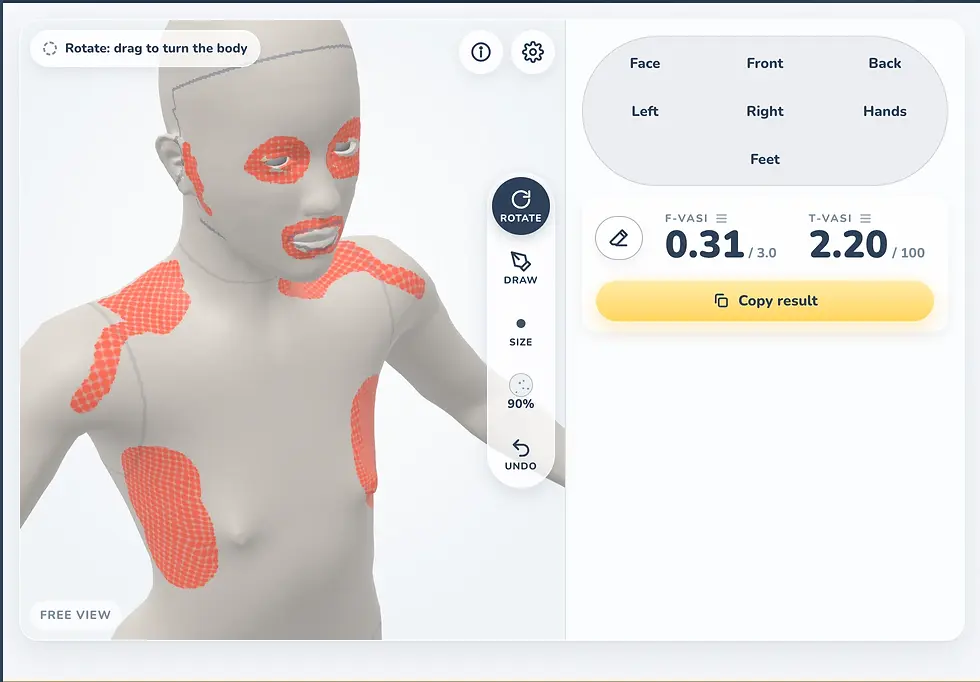
The Bright Med VASI calculator: patches drawn on the face, shoulders and trunk give an F-VASI of 0.31 and a T-VASI of 2.20.
Re-score at each visit with the same method so that F-VASI50 and F-VASI75 responses can be tracked reliably.
Why accurate scoring matters
Eligibility and audit. A documented baseline shows that the patient matches the population NICE appraised and gives you something to measure response against. The facial threshold is small: misjudging the face by half a hand unit can move an F-VASI from below 0.5 to above it.
Response. The TRuE-V primary endpoint was F-VASI75, a reduction of at least 75% from baseline, at week 24. It was reached by 29.8% versus 7.4% on vehicle in TRuE-V1, and by 30.9% versus 11.4% in TRuE-V2 [8]. In the worked example, F-VASI75 would mean falling from 0.72 to 0.18 or below, and F-VASI50 would mean 0.36 or below. In NICE's economic model, a response between F-VASI50 and F-VASI75 at week 24 was counted as no response [6].
What patients notice. Psychometric work suggests that improvements of about 50% in F-VASI and 30% in T-VASI already feel meaningful to patients, so F-VASI75 is a conservative target [11].
Consistency. Use the patient's own hand, score each site in a fixed order, take standardised photographs at each visit, and record the scores from the VASI calculator in the notes.
Learn more with Bright Med. Our dermatology CPD covers vitiligo, alopecia and inflammatory skin disease for primary and secondary care.
Related reading: SALT Score for Alopecia Areata: Free Online SALT Calculator · How to calculate a PASI score accurately across skin tones
Frequently asked questions
What is a VASI score?
The Vitiligo Area Scoring Index measures vitiligo extent by multiplying the affected area in hand units (each about 1% of body surface area) by the level of depigmentation, then adding up all sites [9].
What is the difference between F-VASI and T-VASI?
F-VASI scores the face only (range 0–3). T-VASI scores the whole body, including the face (range 0–100) [10]. The free Bright Med VASI calculator works out both: https://www.brightmed.co.uk/vasi-calculator
What F-VASI score is needed for ruxolitinib cream on the NHS?
NICE TA1140 sets no minimum score. It requires non-segmental vitiligo with facial involvement, age 12 or over, and failure or unsuitability of first-line topical treatments. The TRuE-V trials enrolled people with F-VASI ≥0.5, T-VASI ≥3 and total involvement ≤10% BSA [6, 8].
What does F-VASI75 mean?
At least a 75% improvement in F-VASI from baseline. It was the primary endpoint of the TRuE-V trials at week 24 [8].
Can ruxolitinib cream be prescribed in primary care?
NICE positioned it in secondary care, after topical corticosteroids or calcineurin inhibitors and before phototherapy [6].
When should I refer a patient with vitiligo?
Refer if the vitiligo is rapidly progressing, segmental, covers more than 10% BSA, the diagnosis is uncertain, topical treatment has failed or is unsuitable, or there is significant psychosocial impact [4].
Disclaimer
This article is for educational purposes for healthcare professionals and does not replace clinical judgement, local formularies or current NICE guidance. Topical corticosteroids and calcineurin inhibitors are used off-label in vitiligo. Check the summary of product characteristics before prescribing. Information correct at the time of writing, November 2026.
References
NICE Clinical Knowledge Summaries. Vitiligo: summary and prevalence. Last revised April 2025. https://cks.nice.org.uk/topics/vitiligo/ and https://cks.nice.org.uk/topics/vitiligo/background-information/prevalence/
Bergqvist C, Ezzedine K. Vitiligo: a review. Dermatology. 2020;236(6):571–592. https://doi.org/10.1159/000506103
Lai YC, Yew YW, Kennedy C, Schwartz RA. Vitiligo and depression: a systematic review and meta-analysis of observational studies. Br J Dermatol. 2017;177(3):708–718. https://doi.org/10.1111/bjd.15199
NICE Clinical Knowledge Summaries. Vitiligo: scenario: management. Last revised April 2025. https://cks.nice.org.uk/topics/vitiligo/management/management/
Eleftheriadou V, Atkar R, Batchelor J, et al. British Association of Dermatologists guidelines for the management of people with vitiligo 2021. Br J Dermatol. 2022;186(1):18–29. https://doi.org/10.1111/bjd.20596
NICE. Ruxolitinib cream for treating non-segmental vitiligo in people 12 years and over. Technology appraisal guidance TA1140. Published 17 March 2026. https://www.nice.org.uk/guidance/ta1140
NICE. Ruxolitinib cream for treating non-segmental vitiligo in people 12 years and over. Technology appraisal guidance TA1088. Published 13 August 2025 (replaced by TA1140). https://www.nice.org.uk/guidance/ta1088
Rosmarin D, Passeron T, Pandya AG, et al. Two phase 3, randomized, controlled trials of ruxolitinib cream for vitiligo. N Engl J Med. 2022;387(16):1445–1455. https://doi.org/10.1056/NEJMoa2118828
Hamzavi I, Jain H, McLean D, et al. Parametric modeling of narrowband UV-B phototherapy for vitiligo using a novel quantitative tool: the Vitiligo Area Scoring Index. Arch Dermatol. 2004;140(6):677–683. https://doi.org/10.1001/archderm.140.6.677
Bibeau K, Butler K, Wang M, et al. Psychometric evaluation of the facial and total Vitiligo Area Scoring Index instruments in the TRuE-V phase 3 studies. Dermatol Ther (Heidelb). 2024;14(8):2223–2234. https://doi.org/10.1007/s13555-024-01223-y
Ezzedine K, Soliman AM, Camp HS, et al. Psychometric properties and meaningful change thresholds of the Vitiligo Area Scoring Index. JAMA Dermatol. 2025;161(1):39–46. https://doi.org/10.1001/jamadermatol.2024.4534


